Author: Sosaidh

I am passionate about the arts, books, local current events and politics, and of course freedom. I enjoy learning new jewelry-making techniques.

Progress so far this semester

When I started work this semester, I wanted to continue the narratives I had been doing of political stories that interest me, like the hair-braider who was told by the feds that she couldn’t braid hair in her shop unless she bought expensive sinks and equipment and took expensive cosmetology classes or like the state employees who were outraged that they had to fill out a detailed 31-page health assessment in order to avoid fines. I planned to work in monotype because it’s a new medium I wanted to explore that I honestly didn’t know much about.

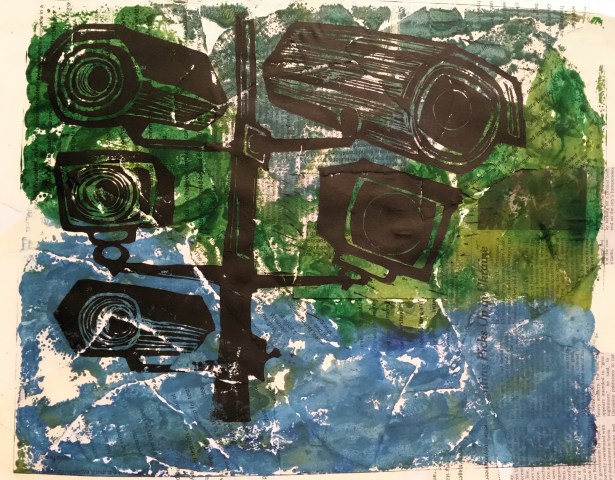
I naively believed that I could make additive prints by painting my stories on my plate. But this has proven difficult. I am learning a new medium which gives various results depending on the absorbency of the paper and the moisture of the pigment. I am trying different combinations. I had to put away the idea for now of working in any kind of detail and focus instead on getting background color where I want it for each piece. I am having luck with this.surveillance state 1

Currently I am mixing different printing techniques: I use monotype for the ground and linoleum print for the design. I have been creating prints of surveillance cameras. Because the monotypes are a bit of an unknown at this point, they are proving to be spontaneous yet vivid backgrounds, a little out of my control. I am never quite sure what I am going to get, depending on the paper and pigments that I use. The block prints, on the other hand, are predictable and controlled. The prints have been evolving as dark order over happy bright spontaneity. This is reminding me of our society: people going about their daily lives, traveling, making many voluntary and peaceful transactions with each other, contrasted with the overlaying grid of the cameras recording our every move. Control and State power over the fluidity of spontaneous order that comes from what might seem like chaos.

I will continue to do these commentaries on our surveillance state in mixed media using various printing techniques.

Michelle Labonte, sad-eyed-artist

I discovered Michelle’s work on the Baker Artist site. I was drawn to her work while browsing for “realism” and “mixed-media”: its multi-layered qualities, vibrant colors, and textures seem to reflect her own varied interests. It’s obvious from reading her captions and her bio that she is involved in many causes. All these interests infuse her art; I find that fascinating. She is from Baltimore and it’s gratifying to learn more about my local art scene. I love it when an artist’s work crosses mediums and reflects the passions of the artist herself. I know I need to work hard at creating a cohesive body of work since my own work will probably always be a mix of techniques so I found her portfolio inspiring.

labontesadeyedartistbroomcorn

  1. Can you describe your artwork?

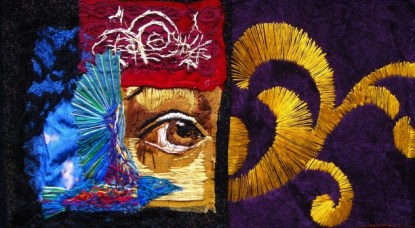
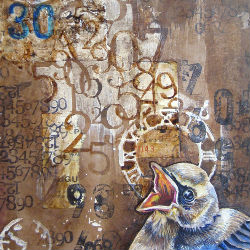
 The city offers a rich vocabulary of colors, textures, and objects that convey emotion. I draw upon this imagery to tell personal, psychological stories of both pain and redemption. In Baltimore, my city, I find my own story, written on concrete skin, walls unafraid to show their scars and healing. I work in many mediums: painting and color-drawing, printmaking, bookbinding, fibers, mixed media, art education, collage, embroidery, low relief assemblage. 
labonte img_2178-2

  1. What is the most important element of your work that you want us to know? 
  1. Materials matter. Every material I choose has significance unto itself, which is just as significant as the imagery or symbolism and is inherent to the message of my work. Finding “my” materials was a HUGE part of finding my voice and my work. “What is your medium?” “Everything.” That was a very freeing and important breakthrough for me. I had seen artists create layered work but didn’t know how to make it my own. I felt like I had to choose: am I a painter? Do I do oil pastel work primarily? Am I a collage artist? (Yes.) How did I make that work with respecting the copyright of other images. (I started with magazine clippings). When I discovered that my entire process included using whatever was important for the work, it freed me up tremendously. I tend to work on wood or paper; generally I don’t work on canvas unless I need to sew. I am well-acquainted with adhesives. I make my own linoleum prints and transfer a lot of images by hand as well. The blending of everything is part of what makes my work my work, and I wish I had been posed the question while in school: “What’s in your toolbox? What are YOUR materials?” I think I would have found my voice sooner and felt more freedom in experimenting with new things. 
  2. Artwork is work. I almost want to delete the word “talent” from our common vocabulary because it tends to indicate this idea that there are some people who are magically able to do art and it’s easy. a. That insults education. Art is a skill-set that can be learned. b. That insults artists. It disregards the hours that were spent making a finished product. It disregards the overcoming of difficult things. Olympian athletes are not “talented”. What may have began as a penchant towards something would not have created an Olympic athlete without the hours and hours of training necessary to hone the skill. Art is no different. To be compared to one’s five-year-old who also has “talent” because they paint too creates a dumbing-down of what art is presumed to be. Five-year-olds and magically talented people do this thing called art; isn’t that cute? Conquering the skillset (or multiple skillsets) is very different than picking up a crayon. Both have significance. The significance, however, of each, is different.  
labontesadeyedartistwaiting-2

  1. Are you involved in art in other ways besides making your artwork?

I’m not entirely sure what this question is asking. I do participate in local critiques and go to gallery events. I think the most significant “other” way I have been involved in art was as a teacher. I taught middle school art, 6-8th grade, for seven years. Teaching was very important to me. It was also very demanding. I was not able to make personal work while teaching (that is to say, during the years of my teaching career) because teaching required all of me. I worked in the county (Anne Arundel) and the City. Last year I was part of something called “The New Day Campaign,” a regional event, wherein art was used as a platform to talk about addiction and mental illness. I played a major role in that campaign, which was over the course of 3 months “officially” (the events and exhibitions took place within 3 months) but behind the scenes, I worked toward or for New Day for the entire year. It was my focus in 2015.  

labonte nowondericantfly2-copy

  1. Has your work changed in the past few years? How so?

My work has changed dramatically over the past few years. During school, and after graduation from MICA, I was not able to find my voice–a maddening reality that carried through almost a decade.I did not know who I was, what my medium was, what to say, or how to say it. I didn’t know my materials. I didn’t know how to keep a sketchbook. Those things evolved very, very slowly. It is so important for me to communicate that my work is not a matter of “talent”. I did not spring up from the womb, paintbrush in hand. For me, finding my work was a matter of honing skills, falling and getting back up, and overcoming enormous discouragement. What looks natural is the result of a lot of hours.

The most significant turning point in my art career was being hospitalized for depression in 2011. I needed to understand that experience. I had kept a small, written journal with me while I was in Sheppard Pratt, but I needed to reprocess everything. I took the information from my journal and began what would turn into “Razorbook,” but at the time, I thought of it as a sketchbook. Having lost my mind, what else was there to lose? I began to make work that I didn’t expect to show, and that gave me a lot of freedom. It was the #1 most significant turning point in my art career. I’d actually say that it began my art career.

labonte rbnowonder-copy

  1. What other artists are inspiring or motivating to you?

David Mack; his work changed how I thought about art, graphic novels, books, fine art, and mixed media. There are plenty of others, and I look at art all the time. However, I had to choose, he stands out as #1.

  1. What are your other interests?

Books were my first love. Reading has been a lifelong, prominent hobby (I don’t know that I’d even call it a “hobby”. Books fed (and feed) me.)

 Writing is a close second, but there would be no writing without reading. 

Stuff. Not high-end stuff, but the sort of stuff-ness of stuff, if that makes sense. As a child I used to collect stickers and magazine clippings. Now I collect a lot of things, most of which come from and directly relate to the city. Metal washers are a favorite. 

But there are amassed purchases, too. For example, I love letter-sets: stamps and stencils. I’m jealous of the old metal ones; they’re so cool.  

Street art (a relatively new interest) here and in other cities. 

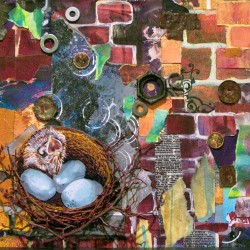
Fabric (depending on the fabric). I’m very tactile. I love to hand-embroider. (But I’m not one to follow patterns. If you look at “Need” from “Consider the birds,” that bird and inner nest is embroidered, rather than drawn in a traditional sense.) 
labonte need-ugly-bird2meg

Baltimore.  

I’m recently trying new things with language. My second language was German, and I spent a lot of time in Germany, but never mastered it. I’d like to achieve fluency.  

I have also begun to take Spanish for completely practical reasons. A major component of my faith is, “love your neighbor.” I find that that’s harder to do when I can’t speak my neighbor’s language. It’s hard. I’ve always been more interested in quiet academia than real-world practicality, so this challenges me that way. I’ve also forgotten how hard it was to learn something from the beginning.  

The inner-world’s of persons, psychology, one-to-one connection; I’d rather go deep than wide with relationships and empathy is a large driving force.

Sound 

Learning 

(/teaching) 

Identity 

The mind


http://bakerartist.org/nominations/view/sadeyedartist
 

Lyndie Dourthe, artist

I have been following this french artist on Facebook and on her blog because I’m fascinated with how her work is a cross between jewelry, hand-sewing, installations, bouquets. Her flowers are simply amazing, such beautiful colors and textures. 

  1. Can you describe your artwork?

I’ve been a visual artist for 10 years now. I design textile sculptures and installations, as well as unique jewellery pieces. I started exploring the universe of botany, by creating hand painted, crafted and assembled flowers. A part of world that I have named ‘Naturalia’. I kept on enlarging the field of this kind of research to natural sciences working on insects, birds and other animals. For these themes, the technique of textile printing is: each piece is printed by a special transfer paper and then stuffed like a little cushion.

Next, the theme of human anatomy, always with the same technique, and that was transformed into research about curiosities, still life, and ex-voto (“an offering to show gratitude or devotion”). This became my ‘Mirabilia’ collection. What mostly interests me in the theme of Time passing by, Time that preserves or decomposes. These pieces are quite often decorated by several materials coming from popular traditions such as the danish or mexican pleated and cut paper techniques.

Everything is structured and presented like personal cabinet of curiosities. ‘Mirabilia’ absorbs actually most of my working time.

My work is an attempt to have a strange, delicate view on our surrounding world, a twisted vision, between violence and smoothness, blossom and putrefaction.

Bones, blood, fruits, butterflies,… everything that is ephemerous and fragile; that fascinates and repulses us at the same time. Every single textile piece tempts to establish the link between body, science, and poetry. 

  1. What piece have you completed most recently?

An installation for a shop window in Nice : http://lyndiedourthe.blogspot.fr/2016/02/le-petit-paris.html – a collaboration with a french design brand.

  1. What are you most proud of?

 To continue to do what I want in my work and to be able to say NO to boring or underpaid projects!

  1. What advice can you give artists?

 Choose your path!

  1. Can you tell us about your background and how this has had an influence on your work?

 My background: I have a diploma in Textile Design from a public applied art school in Paris (School of Design, Fashion, and Creation) in 2002. In France this diploma is called a B.T.S (Brevet de technicien supérieur) – generally 2 years. After my diploma, I did different internships in different companies (very small to very big ones) for 1 year. After these experiments, I decided to become my own boss (!)

The school taught me the basic techniques in creation and imagination and a lot of textile and others techniques, but, not how to start a business… I learned that by my own. I still use a lot of techniques I learned every day, like to make a range of colors or dyeing, for exemple.

  1. What is your studio like? When is the best time for you to work?

 I moved to Nice from Paris last august… Now, I work at home (before in a studio with 7 other artists). I work all the day long but I prefer the morning when everything seems still possible… 😉    I try to keep my ‘home studio’ tidy, to have clear ideas.

  1. What was your best decision?

 To continue with my artistic vision.

  1. Has your work changed in the past few years? How so?

 I don’t know. I go without looking back. I only think about today.

  1. Who inspires you?

 A lot of artists: Louise Bourgeois / Matisse / Annette Messager / Klimt / Rothko / Cocteau / Lucian Freud / Bacon / Françoise Petrovitch / Nathalie Du Pasquier / Rinko Kawauchi / I forget many others !!!

  1. What are your other interests?

Flowers / botanic / insects / mineralogy / mushrooms / birds / fishes / etc… : Nature.  And walking (very important for me) + taking pictures + music + cooking + see people I like…. = ordinary things !


http://lyndiedourthe.blogspot.fr


Mister Finch, artist

I discovered Mister Finch’s work online. His wondrous animals, birds, mushrooms are lovingly made by hand, inspired by nature and by his country’s folklore. With help from his admin, I found these answers to questions I had about his work: 

mr finch1

  1. Can you briefly describe your artwork?

 I am a textile artist who creates nature-inspired pieces from whatever materials I can find. I work alone on limited-edition creations from my studio in Leeds, Yorkshire, UK. With an old sewing machine, I got started using any scraps and materials I had at hand: rescued old clothes, old velvet drapes, tablecloths, discarded wire, steel, wood, silverware. My work responds to what I find fascinating about woodland animals – their life cycles, their mysteries, their extraordinary behaviors. These creatures exist in a magical world where anything is possible. 

  1. What have you completed most recently?

 My latest accomplishment is the gallery exhibition, Mister Finch’s Handmade Museum. The exhibition is a cabinet of curiosities of one-of-a-kind art like overgrown mushrooms, huge moths and butterflies, insects, birds – pretty and poisonous. Here’s the description from the gallery website: “The exhibition immerses the viewer in a makeshift natural history museum that is also a surreal fantasy realm. Made almost entirely from cotton fabric manipulated to dazzling effect, Mister Finch’s Handmade Museum includes over 50 new works by the artist.” Here’s an example: Pink and Orange Dead Birds (hand-sewn sculpture of fabric scraps, plastic, paper, wire, fake flower petals, clay, floral tape, and found objects). 

finch pink orange dead birds

  1. What accomplishment are you most proud of?

Definitely it’s having a solo show in a gallery in New York – at Steven Kasher Gallery. 

  1. What is the most important advice you can give artists?

Avoid negative people. You know what’s best for you, so do that. Focus on everything that can go right, everything that could be amazing and all the places it could take you, not what if it goes wrong. The world is a beautiful place filled with endless possibilities – believe that and that’s the world that will present itself to you. 

  1. Can you tell us about your background and how this has had an influence on your work?

 For a long time I made jewelry, but started to hate how so many people were involved in getting my jewelry produced, photographed, and seen. The fashion scene wasn’t for me. I dug out my sewing machine, I got started sewing, and it all felt right. I never looked back.   

  1. What is your studio like? Do you work and spend time in your studio in the traditional sense?

 My studio is in a home not far from the Yorkshire Dales. It is full of books, glass jars, and naughty cats. My day begins at around 9am. I drink lots of tea, and if I’m in my workroom and not due to leave the house then I usually work for 12 to 14 hours, and this is every day. I really love what I do and I work as hard as I can at it. 

  1. What was your best decision?

To risk everything and start sewing. 

  1. Has your work changed in the past few years? How so?

It seemed I was always looking for the right medium to express myself in and I feel that I have found it. All the things I wanted to create and all the ideas I had for years have now come out in my work. There is so much to constantly learn, new stitches, dyeing techniques. It’s always evolving. 

  1. Who inspires you?

I adore working alone and making everything myself. But I admire anyone who has overcome great obstacles or hardships in his life. And I would love to meet Pierre Jaquet-Droz, the incredible automata creator. 

  1. What else are you passionate about?

Searching for fabric everywhere, collecting old books, finding wooden bobbins and stashing velvet curtains that will come in useful when I get that big old house. Love cats. Watching documentaries, old interviews with faded film stars, sewing spiders late at night, rescuing large metal scissors and getting them sharpened, drinking too much tea, listening to the Cocteau Twins too loud, and hearing a new song and playing it over and over again, small brass chairs and tiny metal shoes, cheese and wine, autumn and watching the summer die and getting all wrapped up, and then when it snows at night and everything is silent, everything is white.


http://www.mister-finch.com


a Baker Artist portfolio

Among the Baker Artist Portfolios (bakerartist.org) I discovered the artwork of Michelle Labonte, also known as sad-eyed-artist. Her focus is Baltimore; she is a MICA graduate, an art teacher formerly at the SEED School of Maryland, a creator of the Baltimore Boys Project where she works with boys in Baltimore City, and a fine artist with a studio practice in east Baltimore. She seems very active and involved!

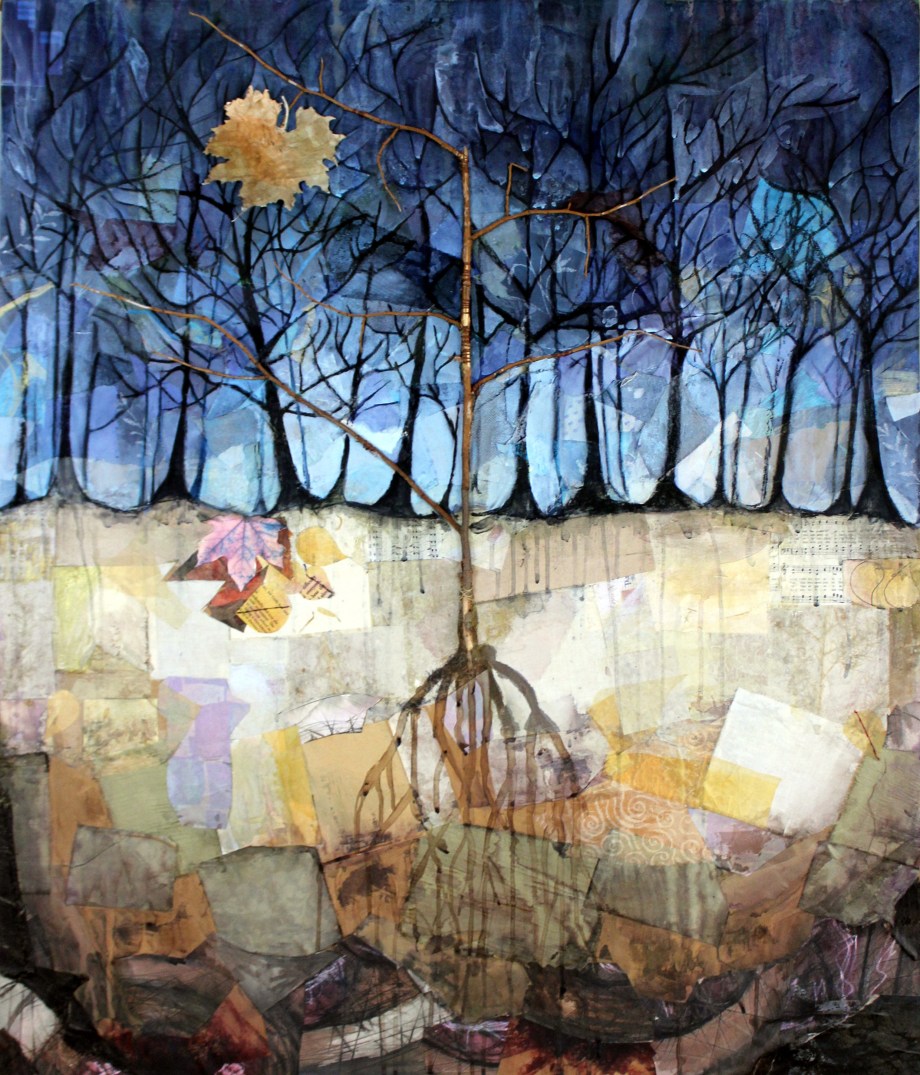
At first glance, her work is varied with different textures, surfaces, and bright colors. This really drew my attention. For example, the first piece that shows up is “Buried Dreams” (3×4’) and is described as using mixed media, fabric, charcoal, ink, acrylic, and a tree branch on stretched paper. This mix of materials intrigues me. The top half of the piece is bright blue with dark trees superimposed. The bottom half looks like a mix of various papers and use of neutral paints with roots overlapping. She gives a detailed explanation of the meaning within the painting, stating, “My life has little by way of hope, and has suffered an unending stream of losses…I could not carry the weight of so many disappointments any longer; I had to bury them, and they stayed buried for a long time.” The piece almost seems to have a quite literal meaning of the death of a dream, trying to find vibrancy in life underground, burying bad memories, and trying to resurrect her dreams.

In this manner, her pieces seem packed with meaning and allusion. Similarly, they make use of a variety of materials. There are rich layers of materials and meaning. This very much appeals to me.

Michelle Labonte bluetreekatphoto

Credit: http://bakerartist.org/nominations/view/sadeyedartist/

International Artists Residency

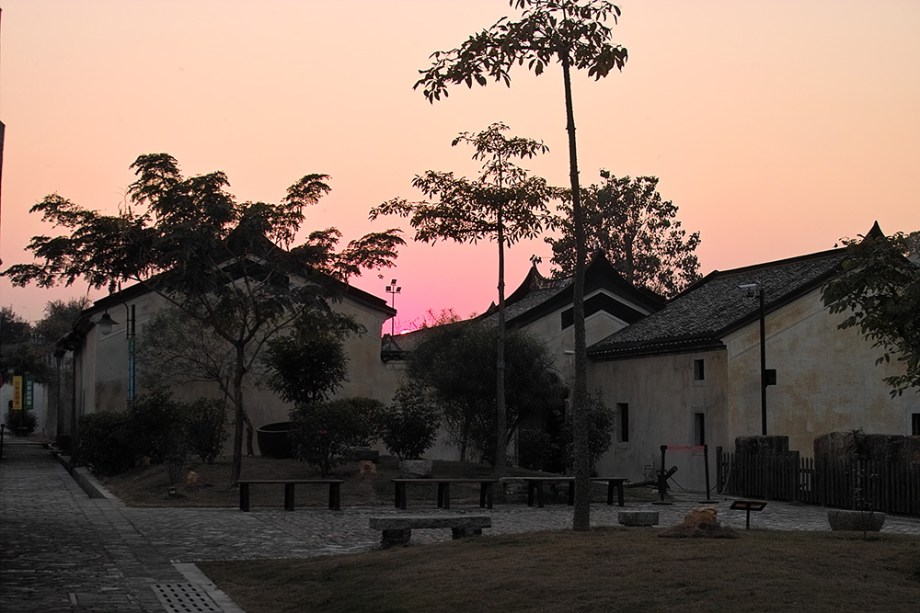
This printmaking base looks like a fantastic place to stay and to work on your printmaking process. It’s an interesting area where traditional homes mix with the new artist village.

Guanlan-Print-Workshop-13_Village

Artists come here from all over the world if they are awarded a residency. The photos are quite inspirational. What a great community environment this would provide for focusing on my work. If I were awarded a residency, I would work on relief printing like woodblocks. I would visit the local art galleries and museums to study the art of this region and learn techniques from their art.

shenzhen-guan-lan-print-artists-village-033

The Base will provide free technical personnel services, quantitative print equipments and materials, international artists’ village for living and cafeteria.

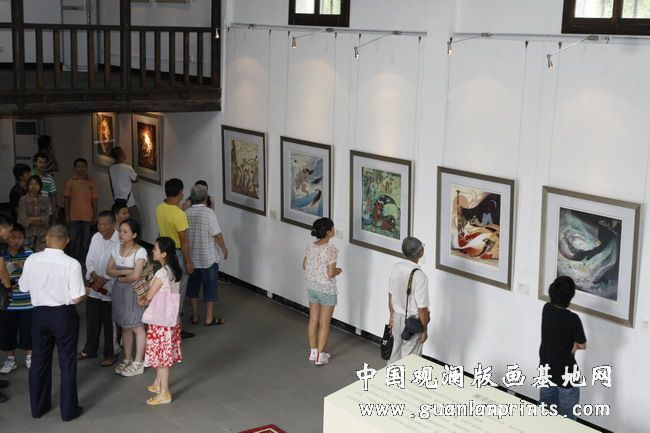
gallery_guanlan10

The print shop will let you dabble in lithography, etching, screen printing, and woodcutting.

International Artists Village in Guanlan China

Here is a video of a visitor arriving at the base

My goals for this term

In my printmaking projects I want to work in monotypes, collographs, linoleum cuts, and woodcut prints. Monotype is a new process for me and I want to see what other artists from the past have produced like Degas, Gauguin, Rembrandt, William Blake, Jasper Johns, Milton Avery, Frank Duveneck, and William Merritt Chase.
I will try both additive and reductive ways of monoprinting, then try using the technique as a backdrop to add together with other kinds of prints.

I want to continue with my theme of news stories that show how we are not free, we are kept as infants, we are kept in debt, we want the State to take care of us, make our decisions for us, keep us safe. I sometimes call these my exposure of ignored horrific events, or my crazy interiors. I have been working in this theme with my paintings but I don’t think the monotypes can be as detailed as paintings.
To begin, I might start off much simpler in terms of composition and concept. I might try more of my paintings of clouds and skyscapes. It will be an opportunity to work on colors and textures.

With the monotypes, I will try a couple different techniques. I’ll try reductive, to start with black ink as the background and remove the ink where the scene is light. I can use different objects to remove the ink for different effects. Afterward I can take ghost prints of these scenes and rework them again into paintings. I can try additive process where I apply the color to draw or create the scene. Try using objects to press into the paper to give texture. I’ve read a suggestion to create the image in four color layers – first apply yellow, then magenta, then cyan, then black. All of these techniques are new to me.

I am interested in low-impact work; for example, using paint and inks that can be easily cleaned up with soap and water and don’t require solvents or turpentines. And not always using a large or etching press. I want to hand-pull prints whenever I can with a baren or a wooden spoon. I am moving into a period in my life where I want to downsize, move into a smaller place, have less possessions, and may not always have a large press available to me. The idea of hand-pulling prints is very appealing to me for a variety of reasons and I plan to explore this option whenever possible. I considered buying a pinpress but it’s expensive and I will try smaller steel rolling pins first.

My last project was paintings of these news stories and events, rather detailed and using realism. It is a challenge for me and each painting takes much longer than I expect because I work in layers. The Monotype printing will be a totally different process: more freely applied paint and more uncertainty as to how the ink will end up being applied.

I will start small, maybe 11×15″ on arches or watercolor paper. Then get larger. The Japanese papers I want to try are about 24×36″ or so. I look forward to the suggestions for how to mat and frame the work professionally.