I discovered Michelle’s work on the Baker Artist site. I was drawn to her work while browsing for “realism” and “mixed-media”: its multi-layered qualities, vibrant colors, and textures seem to reflect her own varied interests. It’s obvious from reading her captions and her bio that she is involved in many causes. All these interests infuse her art; I find that fascinating. She is from Baltimore and it’s gratifying to learn more about my local art scene. I love it when an artist’s work crosses mediums and reflects the passions of the artist herself. I know I need to work hard at creating a cohesive body of work since my own work will probably always be a mix of techniques so I found her portfolio inspiring.

- Can you describe your artwork?
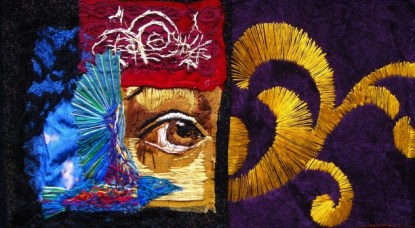
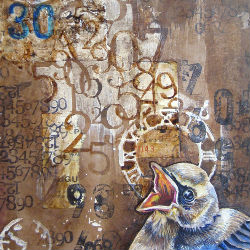
The city offers a rich vocabulary of colors, textures, and objects that convey emotion. I draw upon this imagery to tell personal, psychological stories of both pain and redemption. In Baltimore, my city, I find my own story, written on concrete skin, walls unafraid to show their scars and healing. I work in many mediums: painting and color-drawing, printmaking, bookbinding, fibers, mixed media, art education, collage, embroidery, low relief assemblage.
- What is the most important element of your work that you want us to know?
- Materials matter. Every material I choose has significance unto itself, which is just as significant as the imagery or symbolism and is inherent to the message of my work. Finding “my” materials was a HUGE part of finding my voice and my work. “What is your medium?” “Everything.” That was a very freeing and important breakthrough for me. I had seen artists create layered work but didn’t know how to make it my own. I felt like I had to choose: am I a painter? Do I do oil pastel work primarily? Am I a collage artist? (Yes.) How did I make that work with respecting the copyright of other images. (I started with magazine clippings). When I discovered that my entire process included using whatever was important for the work, it freed me up tremendously. I tend to work on wood or paper; generally I don’t work on canvas unless I need to sew. I am well-acquainted with adhesives. I make my own linoleum prints and transfer a lot of images by hand as well. The blending of everything is part of what makes my work my work, and I wish I had been posed the question while in school: “What’s in your toolbox? What are YOUR materials?” I think I would have found my voice sooner and felt more freedom in experimenting with new things.
- Artwork is work. I almost want to delete the word “talent” from our common vocabulary because it tends to indicate this idea that there are some people who are magically able to do art and it’s easy. a. That insults education. Art is a skill-set that can be learned. b. That insults artists. It disregards the hours that were spent making a finished product. It disregards the overcoming of difficult things. Olympian athletes are not “talented”. What may have began as a penchant towards something would not have created an Olympic athlete without the hours and hours of training necessary to hone the skill. Art is no different. To be compared to one’s five-year-old who also has “talent” because they paint too creates a dumbing-down of what art is presumed to be. Five-year-olds and magically talented people do this thing called art; isn’t that cute? Conquering the skillset (or multiple skillsets) is very different than picking up a crayon. Both have significance. The significance, however, of each, is different.
- Are you involved in art in other ways besides making your artwork?
I’m not entirely sure what this question is asking. I do participate in local critiques and go to gallery events. I think the most significant “other” way I have been involved in art was as a teacher. I taught middle school art, 6-8th grade, for seven years. Teaching was very important to me. It was also very demanding. I was not able to make personal work while teaching (that is to say, during the years of my teaching career) because teaching required all of me. I worked in the county (Anne Arundel) and the City. Last year I was part of something called “The New Day Campaign,” a regional event, wherein art was used as a platform to talk about addiction and mental illness. I played a major role in that campaign, which was over the course of 3 months “officially” (the events and exhibitions took place within 3 months) but behind the scenes, I worked toward or for New Day for the entire year. It was my focus in 2015.

- Has your work changed in the past few years? How so?
My work has changed dramatically over the past few years. During school, and after graduation from MICA, I was not able to find my voice–a maddening reality that carried through almost a decade.I did not know who I was, what my medium was, what to say, or how to say it. I didn’t know my materials. I didn’t know how to keep a sketchbook. Those things evolved very, very slowly. It is so important for me to communicate that my work is not a matter of “talent”. I did not spring up from the womb, paintbrush in hand. For me, finding my work was a matter of honing skills, falling and getting back up, and overcoming enormous discouragement. What looks natural is the result of a lot of hours.
The most significant turning point in my art career was being hospitalized for depression in 2011. I needed to understand that experience. I had kept a small, written journal with me while I was in Sheppard Pratt, but I needed to reprocess everything. I took the information from my journal and began what would turn into “Razorbook,” but at the time, I thought of it as a sketchbook. Having lost my mind, what else was there to lose? I began to make work that I didn’t expect to show, and that gave me a lot of freedom. It was the #1 most significant turning point in my art career. I’d actually say that it began my art career.

- What other artists are inspiring or motivating to you?
David Mack; his work changed how I thought about art, graphic novels, books, fine art, and mixed media. There are plenty of others, and I look at art all the time. However, I had to choose, he stands out as #1.
- What are your other interests?
Books were my first love. Reading has been a lifelong, prominent hobby (I don’t know that I’d even call it a “hobby”. Books fed (and feed) me.)
Writing is a close second, but there would be no writing without reading.
Stuff. Not high-end stuff, but the sort of stuff-ness of stuff, if that makes sense. As a child I used to collect stickers and magazine clippings. Now I collect a lot of things, most of which come from and directly relate to the city. Metal washers are a favorite.
But there are amassed purchases, too. For example, I love letter-sets: stamps and stencils. I’m jealous of the old metal ones; they’re so cool.
Street art (a relatively new interest) here and in other cities.
Fabric (depending on the fabric). I’m very tactile. I love to hand-embroider. (But I’m not one to follow patterns. If you look at “Need” from “Consider the birds,” that bird and inner nest is embroidered, rather than drawn in a traditional sense.)
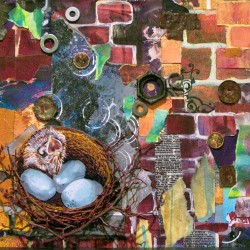
Baltimore.
I’m recently trying new things with language. My second language was German, and I spent a lot of time in Germany, but never mastered it. I’d like to achieve fluency.
I have also begun to take Spanish for completely practical reasons. A major component of my faith is, “love your neighbor.” I find that that’s harder to do when I can’t speak my neighbor’s language. It’s hard. I’ve always been more interested in quiet academia than real-world practicality, so this challenges me that way. I’ve also forgotten how hard it was to learn something from the beginning.
The inner-world’s of persons, psychology, one-to-one connection; I’d rather go deep than wide with relationships and empathy is a large driving force.
Sound
Learning
(/teaching)
Identity
The mind
http://bakerartist.org/nominations/view/sadeyedartist
 suzanne hill